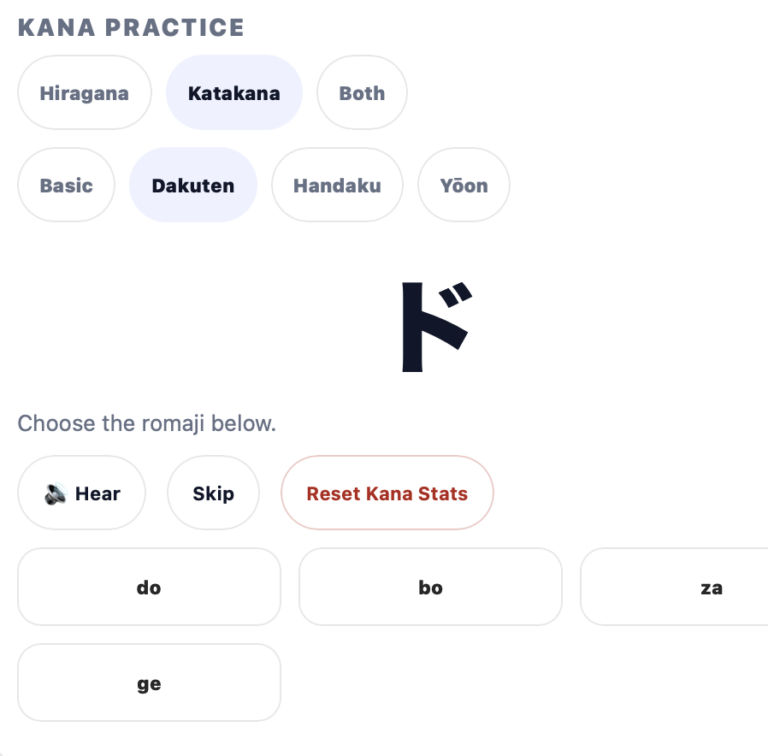
Over the past few weeks, I’ve been building the first working prototype of the Dothiro App — a minimalist web application for learning Japanese kana. Version 0.0 isn’t a finished product; it’s a focused experiment. The goal was simple: to create a clean, distraction-free recognition system that helps learners improve recall speed while staying motivated through light gamification.
This first version centers on hiragana and katakana recognition. It includes basic kana, dakuten and handakuten variations, and yōon combinations. The system randomizes characters intelligently, and missed kana appear more frequently, creating a subtle adaptive learning loop. Instead of overwhelming users with theory, the app focuses on fast recognition, immediate feedback, and repetition.
To support consistency, I implemented a streak system and a daily goal mechanic. Users can track their current streak, best streak, total accuracy, and daily progress through an animated progress ring. When the daily goal is completed, points are awarded. A prototype leaderboard has also been implemented locally, laying the groundwork for a future cloud-based ranking system. For now, everything is intentionally lightweight and simple.
At the moment progress is saved locally per user, allowing persistence between sessions. While cloud integration is not yet active, the structure is already designed to migrate toward cloud synchronization later. The infrastructure supports expansion without needing to rebuild the entire system.
I also began preparing the foundation for N5 Core content, including basic kanji and grammar. The system can now adapt to vocabulary, grammar, and kanji data, which means the curriculum can scale without changing the learning engine. This is important because Dothiro is not just about kana — it is about building a modular learning platform that can grow into N5 through N1, and eventually into specialized industry packs such as agriculture or workforce preparation.
From a technical standpoint, this version was built intentionally using vanilla HTML, CSS, and JavaScript. No heavy frameworks. The goal was clarity, control, and structural understanding. Authentication are integrated, but the backend remains minimal. This is a true MVP — small, stable, and expandable.
Version 0.1 proves something important: the core learning loop works. The UI structure works. The adaptive recognition works. The streak logic works. The system can load structured curriculum data. Most importantly, the idea works.
This is not the final form of the Dothiro App. It is the foundation. The next stages will include cloud-based progress saving, a real leaderboard, N5 kanji quizzes, grammar drills, and eventually N4–N1 expansion. Specialized learning packs will follow after the core system is refined.
For now, v0.0 represents something simple but meaningful — the first concrete step in turning Dothiro from an idea into a working learning system.